Physical Address
304 North Cardinal St.
Dorchester Center, MA 02124
Physical Address
304 North Cardinal St.
Dorchester Center, MA 02124


Few cuts give you the look of shorter hair without losing your length. The butterfly haircut does exactly that: short, face-framing layers sit around the cheekbones and jaw, while long layers keep the length through the back. Blown out, the front pieces flip away from the face like wings, which is where the name comes from.
Below are 25 versions for short, medium, long, straight, wavy, curly and coily hair, from a cheekbone-length face frame you can try before committing, to a wash-and-go cut that skips the round brush entirely, to a silk-pressed version on natural hair.
Quick answer: A butterfly haircut is a heavily layered cut with short face-framing pieces, usually starting at the cheekbones or chin, blended into long layers that keep most of your length. It works best on medium to thick straight or wavy hair at least shoulder length, needs a trim every 8 to 12 weeks, and looks fullest blow-dried with a round brush.
Cost and upkeep are straightforward: expect to pay about $60 to $150 for the cut at most salons, depending on the salon and whether a blowout finish is included, and plan a trim every 8 to 10 weeks. The short layers grow down into the length over time, so the trim is what keeps the face-framing shape sitting where it should.
A butterfly cut has two distinct sections. The top and front are cut into shorter, rounded layers that create volume and frame the face. The underneath and back stay long, with fewer, softer layers. Tuck the long lengths under or pin them up and the short layers can pass for a bob, then fall back into long hair when you let it down.
The classic version needs hair at least to the shoulders, and it looks most dramatic from collarbone length down to the middle of the back. Shorter versions exist, but with less contrast. Density matters more than length: medium to thick hair has enough weight to hold layers without looking thin at the ends. Fine hair can still wear it, but with fewer, longer layers.
Straight hair shows the shape most clearly when blow-dried, but can look flat if left to air-dry. Wavy hair is ideal, because the layers release natural bend. Curly hair works well too, but each layer shrinks as it dries, so short layers can spring up an inch or more. Ask for a stylist who cuts curls dry, one curl at a time.
Where the shortest layer lands changes the effect. Layers starting at the cheekbone lift the face and suit oval, heart and long faces. Layers starting at the chin or jaw soften a square or angular jaw. For a round face, keep the shortest pieces below the chin so they draw the eye down rather than adding width at the cheeks.
The cut looks best with a round-brush or blow-dry-brush finish, which takes most people 15 to 25 minutes. Air-dried, it still looks good, just softer and less “winged.” Plan for trims every 8 to 12 weeks, and a quick fringe or face-frame tidy at 6 weeks if the front starts falling in your eyes.
Bring two or three photos of butterfly cuts on hair like yours, not just pictures you love. Then say where you want the shortest layer to start (cheekbone, lip or chin), how much length you want to keep at the back, and whether you plan to blow-dry or air-dry. Ask your stylist to keep the perimeter strong so the ends don’t look thin.
These three cuts all use layers, but they put them in different places, and the difference decides how the hair falls. This is the fastest way to tell which one you are actually looking at in a photo.
| Butterfly haircut | Wolf cut | Regular layers | |
|---|---|---|---|
| Where the layers sit | Short layers concentrated at the front and crown, blending into full length at the back | Heavy, choppy layers through the top and sides that graduate down like a shag | Layers stepped evenly through the whole head |
| Shortest layer | Around chin level at the front, so the front can read as a shorter cut on its own | Short and textured at the crown, often with a fringe | Usually only a few inches above the longest length |
| Overall shape | Smooth and rounded, with wing-like movement at the front | Deliberately messy and voluminous on top, slimmer at the ends | Even movement throughout, no single focal point |
| Best for | Keeping your length while gaining volume and face framing | Texture, edge and a lived-in finish on wavy or straight hair | Reducing bulk and adding general movement |
| Upkeep | Trim every 8 to 10 weeks to hold the front shape | Grows out softly, so it tolerates longer gaps between cuts | The most forgiving of the three as it grows |
Bring two or three photos and use this wording: “I want a butterfly cut. Keep my length at the back. Put short, face-framing layers at the front that start at my chin, and blend them down into the rest of the hair so there is no visible shelf.” Then agree the measurements before the scissors come out:
One warning worth saying out loud: if you do not want a shaggy finish, tell the stylist so. A butterfly cut and a wolf cut start from similar photos, and the difference is the smooth, blended layering described in the table above.

Picture the version that went viral: long hair, a top section cut into rounded layers starting around the chin, and plenty of air between the pieces. The ends are point-cut or slide-cut so they feel light rather than blunt, and the whole head moves as one soft, bouncy shape.
Medium to thick hair from collarbone to mid-back carries it best. The airy effect comes from removing bulk inside the hair, so if yours is very fine, ask for less texturizing. At home, work a volumizing mousse into the roots and roll the front pieces away from your face with a round brush.

Nervous about a full butterfly? Start with the front. The shortest pieces begin at the cheekbones and cascade down to the collarbone, framing the face in a soft V, while the back can stay almost one length.
Oval, heart and long faces get the most from cheekbone-level pieces, and blown back they open up the eyes. The trade-off is upkeep: face-framing layers grow into your eyes faster than the rest, so book a quick front trim every six to eight weeks. A flat iron with a slight outward bend refreshes it in two minutes.

Most people who picture this cut are really picturing the finish: big, bouncy, rounded layers with lift at the roots, a nod to the supermodel hair of the 1990s. The cut underneath matters less than the blow-dry.
To get it at home, rough-dry your roots upside down, then section the hair and dry each section over a large round brush (about 2 inches across) or a blow-dry brush such as the Revlon One-Step Volumizer. While each section is still warm, roll it in a Velcro roller and leave it to cool for 10 minutes. Brush out with your fingers and finish with a light, flexible hairspray.

Instead of cutting bangs, the front pieces are cut long, around lip or chin length, and parted in the center so they sweep to both sides like curtains. You get the feel of curtain bangs without the commitment, and it grows out without an awkward stage.
Nearly every face shape can wear it, and it’s a smart workaround for cowlicks at the hairline. Style the front pieces with a round brush, pulling them forward and then out, or wrap them around a 1.25-inch curling iron facing away from the face. Clip them back while they cool for the best shape.

Take the same rounded, lifted layers down to a chin-to-jaw-length bob and you have the short butterfly haircut. The crown is layered for height, the front pieces flick outward and the perimeter stays soft rather than blunt.
Fine to medium hair gains the most here, because the shorter length concentrates volume. Thick hair may need internal thinning so it doesn’t puff out. A short cut shows every growth spurt, so plan trims every six to eight weeks. Blow-dry with a small round brush (around 1.5 inches) and bend the ends outward for a ’60s-meets-’90s flip.

Feathering was the signature cut of the 1970s: layers cut and brushed back and away from the face, like feathers on a wing. Combined with butterfly layers on long hair, it gives a soft, retro look with lots of movement.
Save this one for long, medium-thick straight or wavy hair, ideally past the shoulder blades. Blow-dry the front pieces backward with a round brush, then curl the sides outward with a 1.5-inch curling iron. A shine spray or a drop of hair oil on the ends keeps the feathered pieces glossy.

Mix the rounded front layers of a butterfly cut with the choppy, piece-y texture of a shag and you land halfway between the polished blowout and the edgy wolf cut, with more texture than one and less crown height than the other.
Wavy and thick hair handle it best, because the choppy layers release natural texture. Ask for razor or point-cut layers and slightly shorter crown layers than a classic butterfly. Skip the round brush: scrunch a texturizing spray or sea salt spray into damp hair and diffuse or air-dry. It looks better on day two than day one.

Flat-ironed smooth with only a gentle bend at the ends, butterfly layers on straight hair look crisp and polished. No other texture shows the shape as clearly.
The risk is flatness if the layers are too long, so ask for the shortest pieces to start no lower than the chin. Use a heat protectant, blow-dry smooth with a paddle brush, then run a flat iron through each layer with a slight outward turn at the end. A light smoothing oil tames flyaways without weighing the layers down.

Curls turn the cut into a rounded, full shape with lots of bounce around the face. The short layers lift the crown and the longer layers let the curls fall without forming the dreaded triangle.
Book a dry cut, done curl by curl, using a method such as the DevaCut or Rëzo cut, so the stylist sees how each curl springs. Allow for shrinkage, since a curl can spring up much shorter than it looks wet. Style with a leave-in conditioner and a curl cream or gel, then diffuse on low heat.

Between the chin and the collarbone sits the lob, or long bob. Add butterfly layers and you get volume at the crown, flicked-out face-framing pieces and an easy shape that works for the office and the weekend.
As low-maintenance versions go, it’s hard to beat: quick to style and still long enough to tie back. Fine to medium hair wears it especially well. Ask for layers starting at the lip and a slightly heavier perimeter so the ends don’t look wispy. A 1.25-inch curling iron or a flat iron with an outward bend finishes it in under 10 minutes.

Wispy bangs are thin, see-through bangs that sit at or just below the brow. Paired with butterfly layers, they soften the forehead and make the front of the cut feel lighter and fresher.
Oval, long and heart-shaped faces wear them well, and fine to medium hair keeps them airy, since thick hair makes them heavy. They do need daily styling: blow-dry them flat with a small round brush, moving side to side to remove any cowlick. A mini flat iron and a touch of dry shampoo keep them from separating by afternoon.

For many people, shoulder length is the sweet spot: long enough to keep the contrast between short and long layers, short enough to style quickly. The shortest layers usually begin around the cheekbone and fall to the shoulders.
One quirk: ends that brush the shoulders flip in unpredictable directions. Ask your stylist to set the perimeter slightly above or below the point where your hair hits your shoulders. Most hair types and face shapes can wear this length. Blow-dry with a medium round brush and finish the ends outward rather than under.

Natural waves are the easiest texture for this cut, because the layers release your wave pattern and create movement without any heat. This version is designed to dry on its own.
Ask for slightly shorter crown layers than usual, since waves compress as they dry. After washing, apply a lightweight mousse or wave cream to soaking-wet hair and scrunch. Let it dry without touching, then scrunch out the cast. If the front pieces need lift, use a diffuser for two minutes at the roots. Of all 20, it’s the version that needs the least heat.

Too many layers make fine hair look thin, so the fine-hair version uses fewer, longer layers and keeps the weight at the ends. The face-framing pieces do most of the work, and the cut reads full rather than see-through.
Ask your stylist to keep the perimeter strong and skip thinning shears. The shortest layer should start around the chin, not the cheekbone. A root-lifting spray and a round-brush blow-dry add volume; heavy oils and creams take it away. For more cuts designed around fine texture, see our ideas for mid-length haircuts for fine hair.

Thick hair holds butterfly layers beautifully, but without care it can look triangular or bulky. A good stylist removes weight from inside the hair (often called debulking or internal layering) so the outer layers can sit flat and round.
Debulked, the cut moves more and dries faster too. Ask your stylist to take bulk from underneath and through the mid-lengths while leaving the surface layers intact. Blow-dry in sections with a large round brush, use a lightweight smoothing cream against frizz, and expect trims at the 10-to-12-week end of the range.

A money piece is a bright, lighter section of color right at the front hairline. With butterfly layers, the lightest pieces sit exactly where the shortest layers fall, which highlights the cut’s shape and brightens the face.
Book the cut and color together, or color first, so your colorist can place the money piece where the layers will land. Ask for a warmer honey blonde or a cooler beige depending on your undertone. Lightened hair is more fragile, so add a bond-building treatment in the salon, follow up at home with something like Olaplex No.3, and rotate in a purple shampoo every few washes if brassiness creeps in. If you’ve never had this color service before, ask for an allergy patch test about 48 hours ahead.

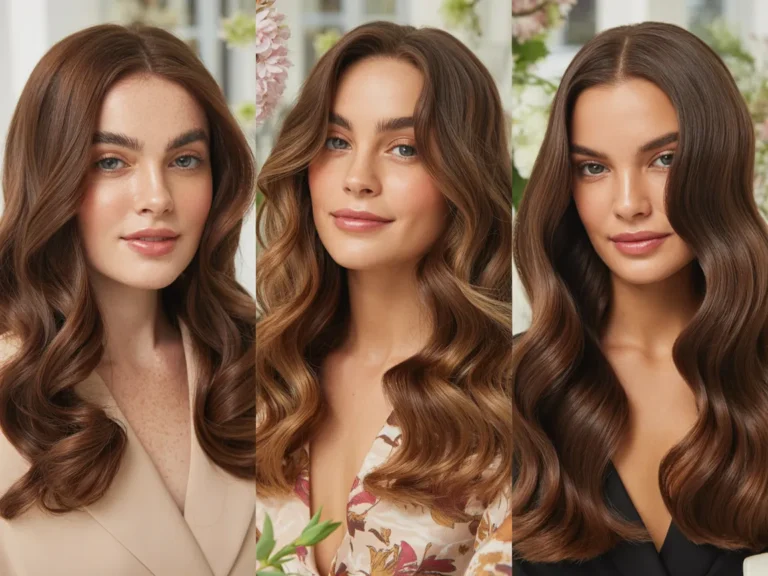
Single-tone dark hair can hide the shape of a layered cut, because there’s little contrast to catch the light. Hand-painted caramel or honey balayage through the mid-lengths and ends makes each layer stand out and adds depth.
Long brown hair around level 4 to level 6 is the natural canvas for it. Ask your colorist to concentrate the lightest pieces on the outer layers and face frame. Because balayage grows out softly, you can often go three to four months between color appointments. Our guide to caramel balayage shows shade options. A strand test helps if your hair has old color on it.

Curtain bangs are shortest in the center, around the brow, and longer at the sides, so they part and fall down each side of the face. On a medium-length butterfly cut, they connect smoothly into the shorter layers, with no hard line between bangs and the rest of the hair.
Square and long faces benefit most: the bangs shorten the forehead and the layers soften the angles at the cheekbones. On a round face, ask for the bangs to sweep longer, past the cheekbones. Blow-dry them forward with a round brush, then split and roll them back to each side. Trim the bangs every four to six weeks; many salons offer quick bang trims between full cuts.

Coily and kinky textures often show this cut off with a silk press, a professional straightening service done with a blow-dryer and flat iron and no chemical relaxer. Pressed, each layer is visible, giving a bouncy, rounded shape with full movement.
Find a stylist experienced with textured hair, and ask whether they cut on pressed or natural hair, since length and shrinkage differ significantly. Heat protection is essential: ask what temperature they use and leave time between presses to keep your curl pattern healthy. When the press reverts, the layers still help coils fall into a rounded shape.

Skip the blowout and the layers look softer and less defined, closer to a long layered cut. That’s what a butterfly haircut looks like unstyled, and it’s fine if you plan for it.
The wash-and-go version uses slightly longer face-framing layers that fall into place without a brush. Apply a leave-in conditioner and a light texture product to damp hair, twist the front pieces away from your face, and let it dry. A quick pass with a flat iron on the front two sections takes a couple of minutes and brings back the “wings.” It’s ideal for busy mornings and low-heat routines.
| Version | Hair it suits | Trim or color schedule | Daily styling |
|---|---|---|---|
| Airy layers, feathered, voluminous blowout | Medium to thick, long | Trim every 8–12 weeks | 15–25 min blowout |
| Face-framing, curtain layers, wispy or curtain bangs | Most types | Front tidy every 4–8 weeks | 5–15 min |
| Short butterfly bob, butterfly lob, shoulder length | Fine to medium | Trim every 6–8 weeks | About 10 min |
| Textured shag, wavy, unstyled | Wavy or thick | Trim every 10–12 weeks | Air-dry |
| Sleek straight | Straight | Trim every 8–10 weeks | 15–20 min |
| Curly, coily with silk press | Curly, coily | Trim every 10–12 weeks | Diffuse, or salon press |
| Fine hair, thick hair debulked | Fine or very thick | Trim every 8–12 weeks | 10–20 min |
| Money piece, caramel balayage | Color-treated | Color every 8–16 weeks | Same as cut |
These four layered cuts are often confused, and the difference matters when you sit in the chair.
Butterfly cut: rounded, smooth short layers at the top and front over long layers, styled with volume. The overall look is polished, bouncy and feminine.
Wolf cut: a mix of a shag and a mullet, with lots of short, choppy crown layers and thinner, wispy lengths at the back. It’s edgier and more textured, and usually worn with bangs.
Shag: choppy layers throughout the head, often with bangs, designed to look piece-y and undone. It loses more overall length than a butterfly cut.
Long layers: a traditional layered cut, with layers spaced evenly and blended so there’s no obvious short section. It’s subtler, and it lacks the butterfly cut’s dramatic short front.
If you aren’t sure, start with long layers and a face frame. You can always go shorter at the next appointment, but you can’t add length back.
A deep side part changes the whole balance of a butterfly cut. Instead of the even wings of a middle part, the longer side sweeps across the forehead and drops into the face-framing layers, which gives the front a softer, more glamorous fall. It is the simplest variation to try because it needs no new cut, only a new part line on a cut you already have.
Part the hair while it is damp, then blow-dry in the direction of the part with a round brush so the roots set that way. The shorter layers on the heavy side create most of the volume, so keep product light there. This works especially well if your face-framing layers have grown a little past chin level, because the sweep uses that extra length.
Butterfly layering works past the waist too, and at that length it solves a specific problem: very long hair that hangs in one flat sheet. The short front layers and a lifted crown break up the sheet, while the back keeps its full dramatic length. The result reads as two styles at once, short and full at the front, extra-long from behind.
The cut needs the layer steps spaced wider than usual, because short steps on very long hair create a visible shelf halfway down. Ask for the graduation to start at the chin and stretch gradually to the ends. Thick hair benefits most, since the layering removes the weight that makes extra-long hair pull flat at the roots.
Round faces need the wings placed with more care, because volume at the cheeks adds width exactly where a round face is already widest. Shaped correctly, a butterfly cut lengthens the face instead: the lift goes at the crown, and the face-framing layers fall below the chin, drawing the eye down rather than out.
Ask for the shortest layer to start at or below the chin, never at the cheekbones, and keep the sides sleek rather than flicked outward. A middle or slightly off-center part strengthens the lengthening effect. Styled with a smooth blowout through the front pieces, this version keeps all the movement of the cut while giving the face a longer, more oval outline.
A money piece is a single bright section of color at the front hairline, and it was made for this cut. Because the butterfly’s shortest layers sit exactly where the money piece is placed, the bright strands become the most mobile part of the style, catching light every time the wings move. It is a smaller commitment than coloring the whole head.
Keep the bright section narrow, roughly the front two inches on each side of the part, and take it one to two shades lighter than the rest rather than jumping to a high-contrast blonde. The placement follows the face-framing layers you already have, so it can be added at a color appointment without changing the cut at all.
Most butterfly cuts feather the ends, but keeping the perimeter blunt gives the style a cleaner, more deliberate outline. The layers still do their work at the front and crown, while the bottom edge stays full and straight. For fine hair this is often the better version, because feathering already-thin ends can make them look wispy and sparse.
Ask for the internal layering exactly as described above, then have the very ends cut straight across with no texturizing. The contrast between the soft front and the solid baseline is what makes the shape read clearly. Style the front pieces with a round brush and leave the ends smooth, so the two finishes stay distinct.
It’s a layered cut with two parts: short, rounded layers around the face and crown, and long layers at the back that keep most of your length. When blow-dried, the front layers flip away from the face like wings. It draws on the feathered cuts of the 1970s and the voluminous blowouts of the 1990s.
A regular layered cut spaces layers evenly through the hair for gentle movement. A butterfly cut creates a clear contrast: much shorter layers at the top and front, often starting at the cheekbones, with long lengths left underneath. The result has more volume around the face and can even look like a bob when the long lengths are tucked away.
Very fine or thin hair can look sparse with many short layers, and anyone who wants a no-styling, one-length look may find the cut fussy. Hair shorter than the chin has little room for contrast. If you dislike heat styling and have straight, flat hair, ask for a softer version with fewer, longer layers.
It can be, with changes. Ask for fewer layers that start around the chin, keep the perimeter strong and avoid thinning shears. A root-lifting spray and a round-brush blow-dry add volume. A face frame on its own often gives thin hair the butterfly effect without removing too much weight from the ends.
Most butterfly cuts need a trim every 8 to 12 weeks to keep the layers shaped. Face-framing pieces and bangs grow out faster, so many people book a quick front trim every four to eight weeks. Short versions, such as a butterfly bob, need trims more often, about every six to eight weeks.
Yes. It has stayed a popular request since it took off on social media, and it keeps evolving into softer, more wearable versions, such as wash-and-go cuts and face-frame-only styles. Because it’s based on classic layering, it grows out gracefully into long layers when you’re ready for a change.
The best butterfly cut is the one that matches your hair type and your morning routine: thick and wavy hair can go bold, fine hair needs fewer layers, and curls need a dry cut. Decide where your shortest layer starts, keep your length at the back and bring photos on hair like yours. If you’re planning a color refresh to go with the new cut, see our guide to brown hair colors or browse more hair style ideas.